|

PredictSuperFam - PSS-3D1D
Developed by K. Muthuvel Prasath1 K. Ganesan2 and S. Parthasarathy3*
1&3Dept. of Bioinformatics, Bharathidasan University, Tiruchirappalli 620 024, India
2Department of Biotechnology,IIT Madras, Chennai 600 036, India
* For correspondence
bdupartha@gmail.com
Limitations - Example and Explanation
Limitations
i) Our method is better for predicting superfamilies from the Twilight Zone sequences (15 – 25% identity) only. If the sequence identity is higher, other methods may be preferred.
ii) The ‘all vs all’ benchmarking predicts only 95.5% of the superfamilies, though the sequence identity is 100%. It is a limitation of our method that 4.5% of the superfamilies are not predicted within top 5 ranks (Supplementary Table S2). This indicates that the PSS-3D1D scoring process of our method has limitations in predicting these sequences available in our ‘Superfamily profile library’.
iii) Our method is less sensitive for the sequences, which fall under the ‘Single fold with multiple superfamilies’ category compared to that of ‘Single fold with single superfamily’ category (Supplementary Table S5).
Example: a SGNH-hydrolase family esterase (PDB ID: 6IQ7)
The 'A' chain of PDB ID: 6IQ7 sequence belongs to the Flavodoxin-like fold (SCOP ID: c.23), SGNH hydrolase Superfamily from the SCOP database. The input sequence submitted in FASTA format is shown in Figure 1 and exhibits 20.2% sequence identity (Twilight Zone sequence within the 15-25% identity range) with our ‘Superfamily Profile Library’ sequences (Figure 2).
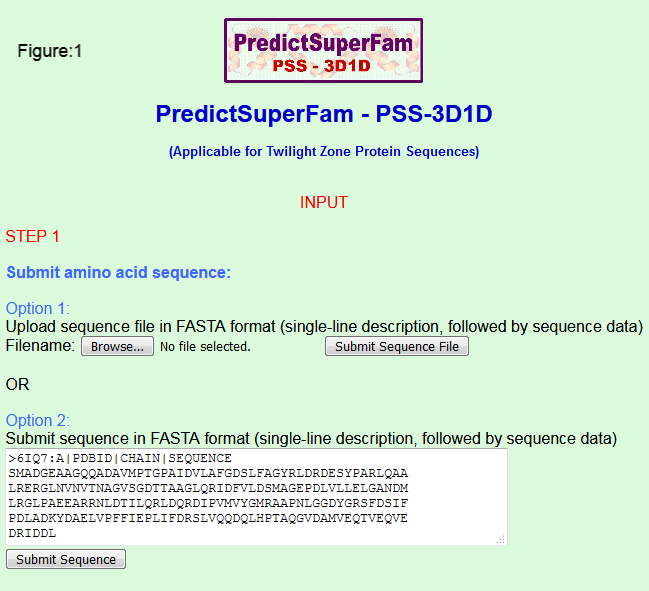
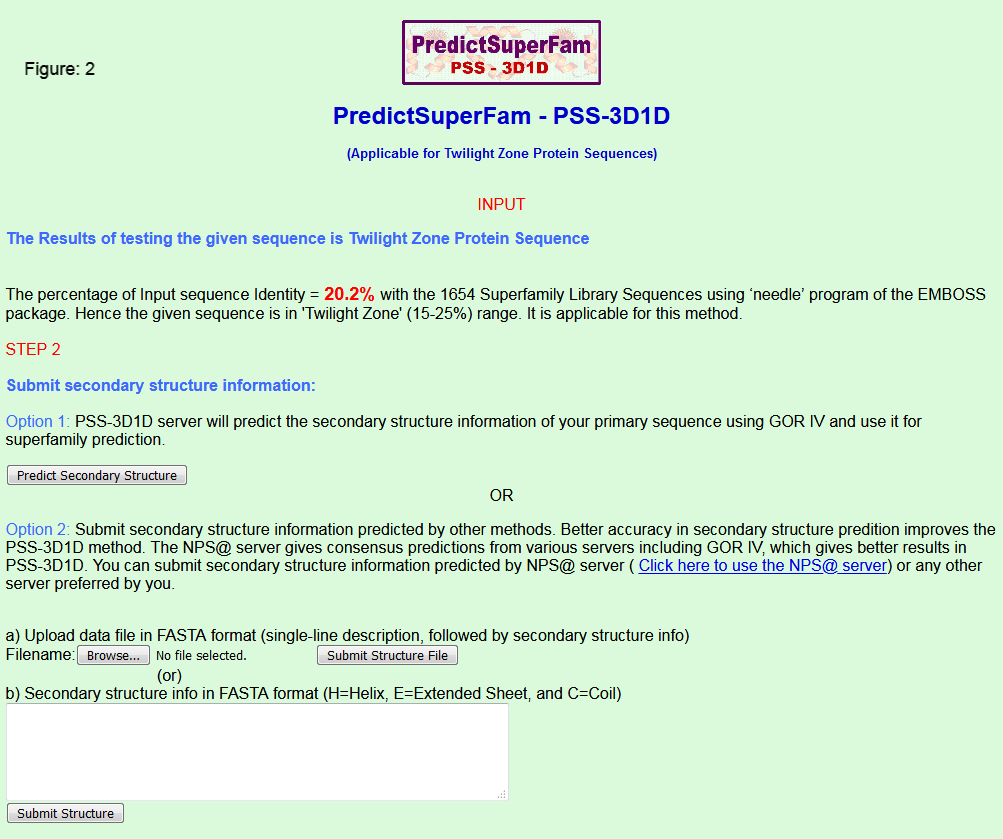
However, the input sequence possesses only 11.2% sequence identity with exact SGNH hydrolase Superfamily (sccs ID: c.23.10) obtained using the ‘needle’ program of the EMBOSS package. Hence, the prediction of superfamily by our method is very low and the results are given below and also in Table 1.
Table 1: The Results of 6IQ7 sequence with superfamilies belonging to Flavodoxin-like fold (SCOP ID: c.23) from PredictSuperFam-PSS-3D1D server
| Sl. No. |
SCOP ID |
Representative PDB Chain |
Superfamily Name |
Sequence Identity* (%) |
Rank / Position |
| NPS@ server |
GOR Method |
| 1. | c.23.5 | 2fcr_A | Flavoproteins |
15.6 | 21 | 94 |
| 2. | c.23.13 | 1h05_A | Type II 3-dehydroquinate | 7.6 | 56 | 54 |
| 3. | c.23.4 | 2nu7_A | Succinyl-CoA synthetase d | 5.8 | 60 | 68 |
| 4. | c.23.11 | 1x38_A | Beta-D-glucan exohydrola | 12.0 | 277 | 300 |
| 5. | c.23.10 | 1esc_A | SGNH hydrolase | 11.2 | 286 | 417 |
| 6. | c.23.14 | 1f8y_A | N-(deoxy)ribosyltransfer | 13.7 | 443 | 635 |
| 7. | c.23.3 | 1eiw_A | Hypothetical protein MTH5 | 11.0 | 781 | 634 |
| 8. | c.23.8 | 1qcz_A | N5-CAIR mutase (phosphori | 9.9 | 866 | 439 |
| 9. | c.23.2 | 1fyv_A | Toll/Interleukin receptor | 8.7 | 964 | 764 |
| 10. | c.23.1 | 1jbe_A | Flavodoxin-like | 13.6 | 1021 | 902 |
| 11. | c.23.17 | 1f2v_A | Precorrin-8X methylmutas | 17.1 | 1389 | 1348 |
| 12. | c.23.12 | 2nac_A | Formate/glycerate dehydr | 12.4 | 1600 | 1558 |
*Sequence Identity (%) is obtained using the ‘needle’ program of the EMBOSS package
Explanation
We have included 12 out of 15 superfamilies for Flavodoxin-like fold in our ‘Superfamily profile library’ (listed in above table) and for 6IQ7_A sequence along with its secondary structure (predicted by GOR method), the Type II 3-dehydroquinate superfamily is predicted in 54th position with SCOP ID c.23.13 (1h05_A). The Flavoproteins superfamily with SCOP ID c.23.5 (2fcr_A) is predicted at 21st position by using Consensus secondary structure information for the input 6IQ7_A sequences.
For any given TZ sequence belongs to ‘Single fold with multiple superfamilies’ category exhibits slightly less prediction compared to that of ‘Single fold with single superfamily’ category.
| |
 Techcmantix Technologies Pvt Ltd.